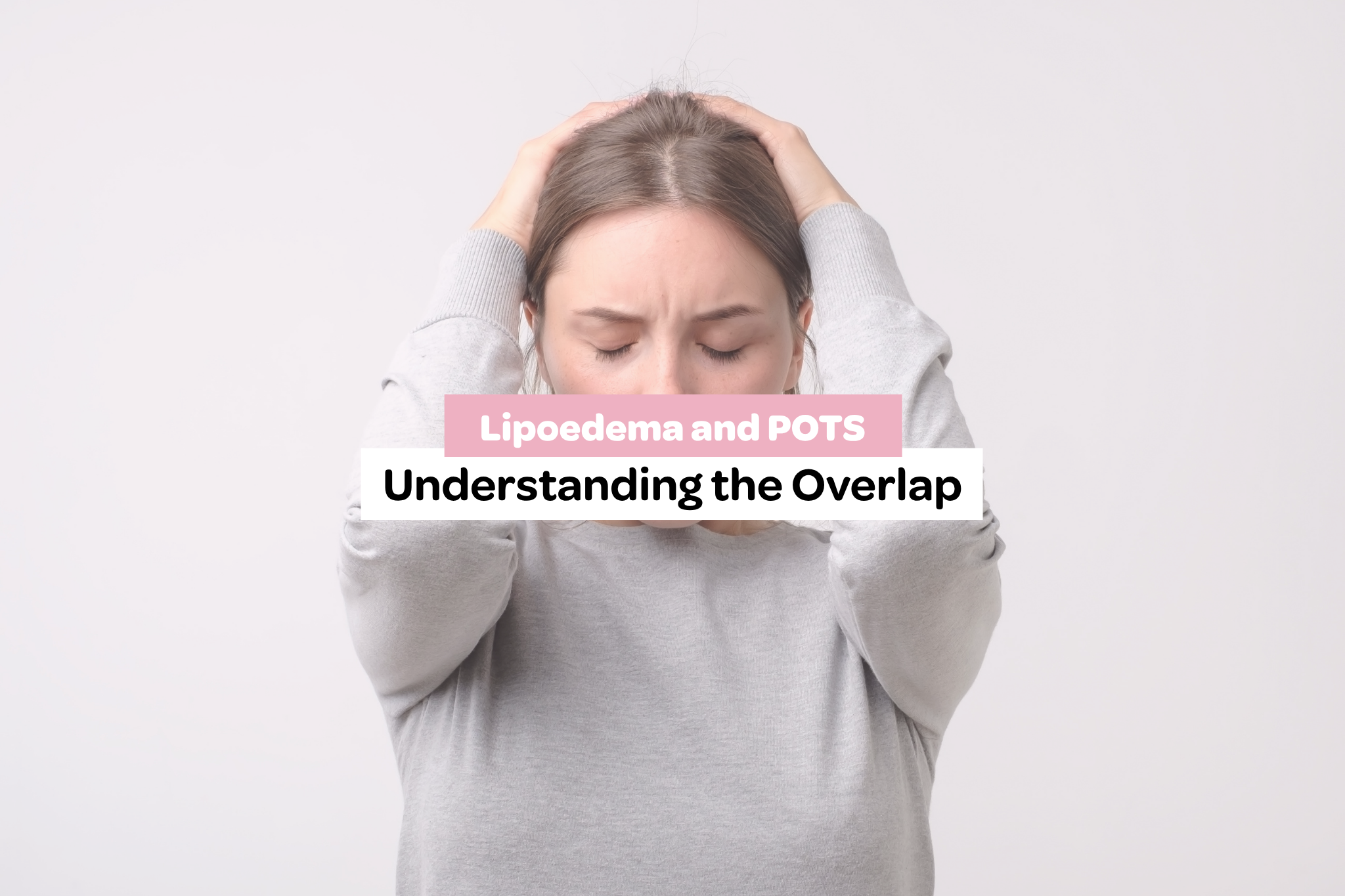
Postural Orthostatic Tachycardia Syndrome, more commonly known as POTS, has received increasing attention in recent years.
A recent ABC News story highlighted the experiences of young Australians living with POTS, including the challenges of having symptoms that can be significant and disabling while remaining largely invisible to the people around them. It also highlighted a problem that will feel familiar to many women living with lipoedema: the long search for answers when a condition is not well understood.
For people with lipoedema, POTS is worth understanding because there can be an overlap in symptoms and associated conditions, particularly where joint hypermobility and connective-tissue differences are also present.
However, it is important to be clear about what we know and what we are still learning. Having lipoedema does not mean you have POTS, and one condition has not been shown to cause the other.
What emerging research does tell us is that there may be connections worth recognising, particularly when symptoms extend beyond those usually associated with lipoedema.
What is POTS?
POTS is a condition involving the autonomic nervous system.
The autonomic nervous system regulates many of the functions our body performs automatically, including heart rate, blood pressure, digestion and aspects of circulation.
When we move from lying or sitting to standing, the body normally adjusts our circulation to maintain blood flow to the heart and brain. In someone with POTS, this response does not work as it should. Their heart rate rises significantly when they become upright, and this occurs alongside symptoms known as orthostatic intolerance, which simply means difficulty tolerating an upright position.
Current diagnostic criteria generally include a sustained increase in heart rate of at least 30 beats per minute in adults within 10 minutes of standing, or at least 40 beats per minute in adolescents, without a significant fall in blood pressure. Symptoms are generally required to have been present for at least three months, and other causes of an increased heart rate need to be excluded.
Assessment may include measurements of heart rate and blood pressure while lying and standing, or a tilt-table test, together with a detailed medical history.
People with POTS can experience symptoms very differently. Some notice dizziness or light-headedness when they stand, while others experience a racing or pounding heartbeat, fatigue, brain fog, weakness or reduced exercise tolerance. Some people may feel faint or actually faint, while prolonged standing can make symptoms noticeably worse.
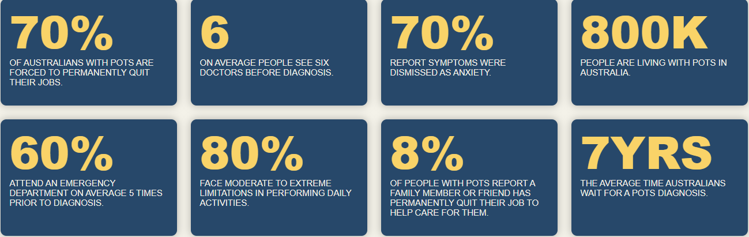
The Australian POTS Foundation estimates that more than 800,000 Australians are living with POTS, with women making up the large majority of those affected. Symptoms commonly begin during adolescence or early adulthood.
What is lipoedema?
Lipoedema — also commonly spelled lipedema — is a chronic condition characterised by a disproportionate accumulation of affected adipose and connective tissue, most commonly in the legs, hips and sometimes the arms.
It almost exclusively affects women and commonly develops or changes during periods of hormonal change.
The condition can cause disproportionate enlargement of the legs or arms, pain or tenderness within the affected tissue, easy bruising, feelings of heaviness or pressure and changes in mobility as the condition progresses. Some women also experience swelling or fluid-related symptoms.
One important part of our evolving understanding of lipoedema is that it should not be viewed simply as a condition of excess body fat.
Research increasingly identifies changes involving connective tissue, blood vessels, lymphatic function and the wider tissue environment. Joint hypermobility and connective-tissue laxity have also been reported relatively frequently among people with lipoedema.
This is one of the reasons researchers are becoming increasingly interested in the broader health conditions that may coexist with lipoedema.
The connection between lipoedema and POTS
Lipoedema and POTS are separate conditions, but there are some areas of overlap that researchers are beginning to explore.
One of the clearest areas of interest is joint hypermobility and connective tissue. Research involving people with lipoedema has identified relatively high rates of joint hypermobility and features associated with connective-tissue laxity. In one recent observational study, 44% of participants with lipoedema reported current joint hypermobility, while 60% recalled being hypermobile during childhood.
Hypermobility is also frequently reported in people with POTS. A recent systematic review and meta-analysis found joint hypermobility syndrome in approximately 31% of people with POTS included in the studies analysed. Other research has similarly identified an association between POTS and hypermobility spectrum disorders, including hypermobile Ehlers-Danlos syndrome.
This shared association with hypermobility is one reason the two conditions may sometimes appear in the same person. However, research has not established that lipoedema directly leads to POTS, or that the presence of one condition predicts the other.
There can also be some similarity in the way symptoms are experienced. Fatigue and reduced exercise tolerance, for example, are reported in both populations, although the underlying reasons may be very different. In someone with lipoedema, these symptoms may relate to pain, tissue heaviness or reduced mobility, while in POTS they may be associated with orthostatic intolerance and autonomic dysfunction.
For women living with lipoedema, the important point is that symptoms such as dizziness, palpitations or a marked increase in heart rate when standing should not automatically be attributed to lipoedema. If these symptoms are present, they may warrant separate assessment.
Research into lipoedema, hypermobility and dysautonomia is continuing to develop. At this stage, the evidence supports recognising possible areas of overlap while remaining careful not to assume a direct relationship where one has not yet been established.
Some symptoms that can look similiar:
Another reason POTS can be overlooked in someone living with lipoedema is that several symptoms can occur across both conditions.
Fatigue is a good example.
A woman with lipoedema may experience fatigue because painful or heavy legs make movement more difficult. Someone with POTS may experience profound fatigue because remaining upright places additional strain on their autonomic and cardiovascular systems.
Reduced exercise tolerance can also occur in both conditions, although for very different reasons. Feelings of heaviness in the legs, weakness, chronic pain and difficulty remaining upright for long periods can further complicate the picture.
When several symptoms are present at once, it can become difficult to know where one condition ends and another begins.
This does not mean those symptoms necessarily indicate POTS. It means they should be considered within the context of the whole person rather than automatically being attributed to lipoedema.
When might POTS be worth discussing with your doctor?
If you have lipoedema and regularly experience symptoms that are strongly associated with becoming upright, they are worth discussing with your GP or treating doctor.
For example, you may notice that you become dizzy when you stand, your heart begins racing after becoming upright, or you feel faint after standing for a period of time. Some people also find that prolonged standing is particularly difficult, or that symptoms improve once they sit or lie down.
Persistent and otherwise unexplained fatigue can also be worth discussing, particularly if it occurs alongside palpitations, dizziness or difficulty tolerating an upright position.
These symptoms can have many possible causes, and POTS is only one of them. Conditions such as dehydration, anaemia, thyroid disorders, medication effects and other cardiovascular or autonomic conditions may cause similar symptoms.
That is why appropriate and holistic medical assessment matters.
Why recognising comorbidities matters in lipoedema
At Lipoedema Surgical Solution, we believe understanding lipoedema means looking beyond the affected tissue alone.
Women can arrive at our clinic with a combination of symptoms and health conditions that may influence how they feel, how they move, how they tolerate treatment and how their individual care should be approached.
For some, this may include venous disease or lymphatic dysfunction. For others, joint hypermobility, connective-tissue differences or another medical condition may form part of the broader picture.
This can also become relevant when planning treatment. If symptoms suggest another condition may be contributing to a woman’s health or circulation, further assessment may be appropriate before moving forward.
Our aim is not to attribute every symptom to lipoedema. Where something requires assessment outside our area of care, identifying that and involving the appropriate clinician is an important part of building a safe and considered treatment pathway.
When symptoms have been dismissed before
There is also a shared experience between many people living with lipoedema and people living with POTS that cannot be ignored.
Both conditions have historically been poorly recognised.
Women with lipoedema may have spent years being told their symptoms are simply related to weight, even when their pain, bruising, disproportionate tissue distribution and other symptoms suggest something more complex.
People living with POTS may also experience a long path to diagnosis, particularly when symptoms such as dizziness, palpitations, fatigue or brain fog are initially attributed to anxiety or other causes.
For someone experiencing symptoms from more than one condition, that search for answers can become even more complicated.
This is why persistent symptoms deserve thoughtful investigation rather than being automatically explained by an existing diagnosis.
Receiving an explanation for symptoms is not simply about giving them a name. It can help ensure that management is more appropriate to what that person is actually experiencing.
Looking at the whole person
Our understanding of lipoedema continues to develop.
We now know that the condition is more complex than the appearance or distribution of affected tissue alone. Research into connective tissue, vascular changes, lymphatic function, inflammation and associated conditions continues to broaden our understanding of how lipoedema may affect different women.
POTS is one piece of that wider conversation.
We do not yet have all the answers about the relationship between the two conditions, and it is important not to overstate the evidence.
What we can do is recognise when symptoms do not fit neatly within lipoedema and make sure they are not automatically dismissed or overlooked.
At Lipoedema Surgical Solution, our approach begins with understanding the individual, their symptoms, history, associated conditions and goals before considering what management or treatment may be appropriate.
Because good lipoedema care is not about treating one part of the body in isolation. It is about understanding the person living with the condition.
Learn more about lipoedema
If you have lipoedema, think you may have lipoedema, or are trying to better understand how the condition may relate to other aspects of your health, education is a useful place to begin.
Our online Lipoedema Education Session provides an introduction to lipoedema, including how it is recognised, conservative management, associated health considerations and the Lipoedema Surgical Solution care pathway.
You will also have an opportunity to ask questions and better understand what your next steps may look like.
To learn more, call 1800 367 534 or book in for an upcoming Lipoedema Education Session.
This article provides general health information only and is not a substitute for individual medical advice. It does not diagnose lipoedema, POTS or any other condition. If you are concerned about symptoms of POTS or another medical condition, speak with your GP or an appropriately qualified medical practitioner.
Further reading
ABC News, More young women being diagnosed with POTS but rural patients face extra toll, 19 August 2026.